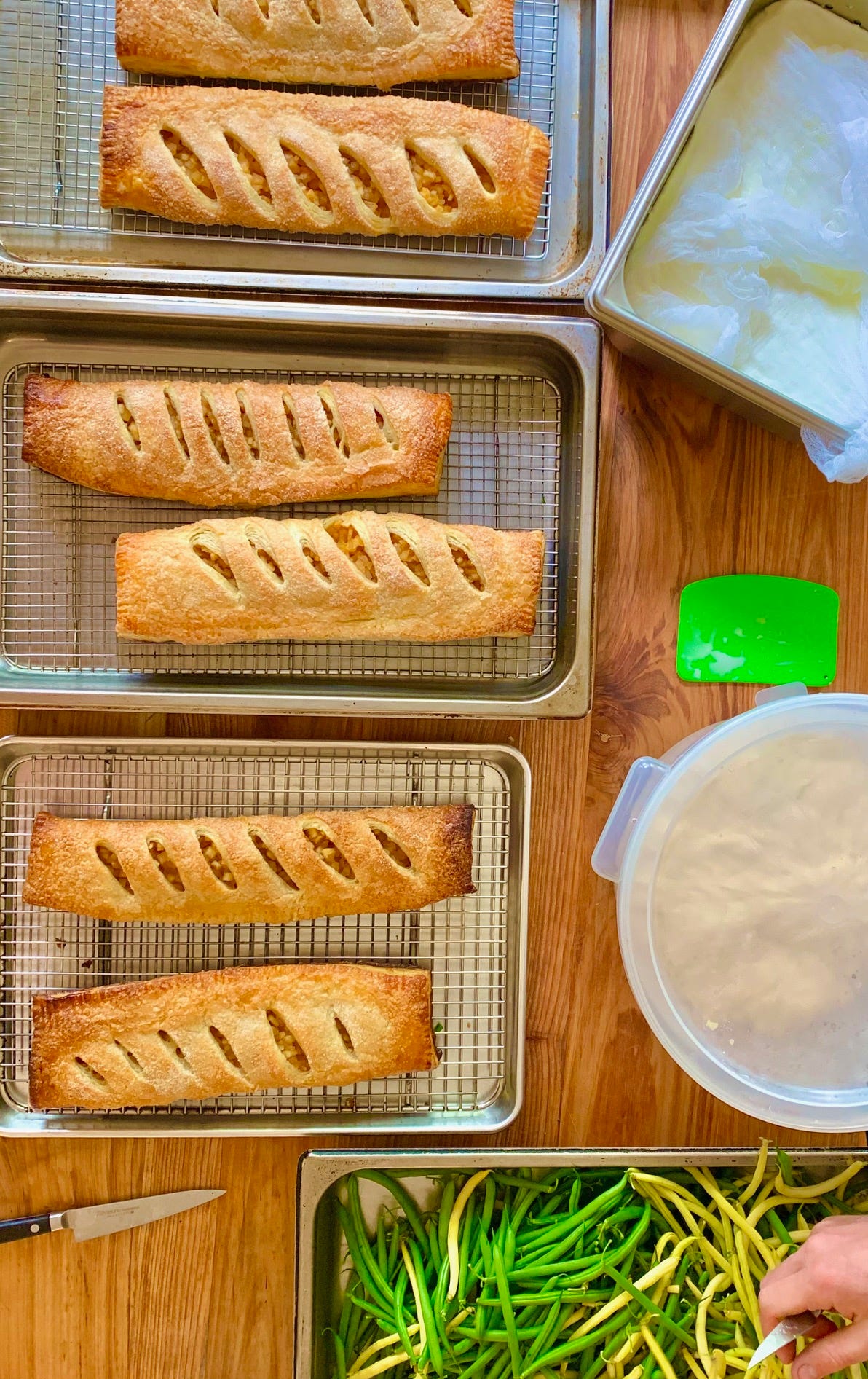
Last Saturday morning I woke up early to go canvassing in Upstate New York for a handful of local races. I rushed out the door without eating, just a black coffee in hand. Nothing I love much more than a solo car ride with a cup of coffee, but by the end of the two hour stretch my blood sugar was dipping and I was ravenous. There is a farm stand off of route 9H that I stop into whenever I drive by. It’s a great farm, with particularly nice stone fruit, but I’m only there for the apple sticks. I’ve been eating these since I was very young. Objectively they are not that good. They are underbaked, reaching only a pale blond color, as though they were pulled out of the oven five minutes too soon. The pastry tastes like it’s made me Crisco, not butter. For some reason, none of this matters to me. I adore them and they bring me immense comfort. I suspect others feel the same as they are always sold out. But not on this early Saturday morning. I was greeted by an overflowing tray of them, fresh out of the oven. So I got six, of which I ate five and a half (over the course of the weekend), giving only one half to my mother. Not because I was hogging them, but because no one else seems to like them like I do. Hard to express the feeling of contentedness I felt sitting in the back of a barn with my warm bag of strudels, watching the canvassers assemble.
When I was a kid, in the fall after school, my mom would often make a baked apple snack of some kind. Either sautéed apples and walnuts with yogurt or whole roasted apples with cold cream. In high school, I could count on either my boyfriend or my best friend to bring me a apple strudel from Le Pain Quotidien once or twice a week for breakfast. Today, when I overlap with my dad in the city, he will usually greet me with an apple turnover. It is true comfort food for me, and in this nail-biting fall, with only 52 days remaining in this election cycle, seeking out comfort is a high priority. Though you can make the classic turnover triangles from this recipe, I prefer to make one large format turnover. It requires less work yet feels more impressive.
If you don’t have it in you to make puff pastry, buy it from the store!
Puff Pastry
You want to work quickly with this recipe in order to keep the butter cold. What makes puff pastry flaky is the distinct layers of butter striated throughout the dough. We don’t want a totally homogenous and dense dough, a result of warm butter, so we work quickly with cold butter to avoid this. You don’t need to rush, just don’t dilly dally.
500g flour
500g butter, cubed and cold
12g sugar
12g salt
1/2 C ice water, approximately
In a bowl, mix to combine the flour, salt, and sugar. Add in the cold butter, coating in flour first then pinching the chunks of butter between your fingers to incorporate into the flour. Drizzle in 1/4 cup of ice water and begin to combine the dough with your hands. Add more water if necessary. Press the dough into two discs. It’s ok if the dough feels a little dry it will hydrate more in the fridge. Using a rolling pin, flatten out the dough then wrap in plastic wrap. Refrigerate for an hour.
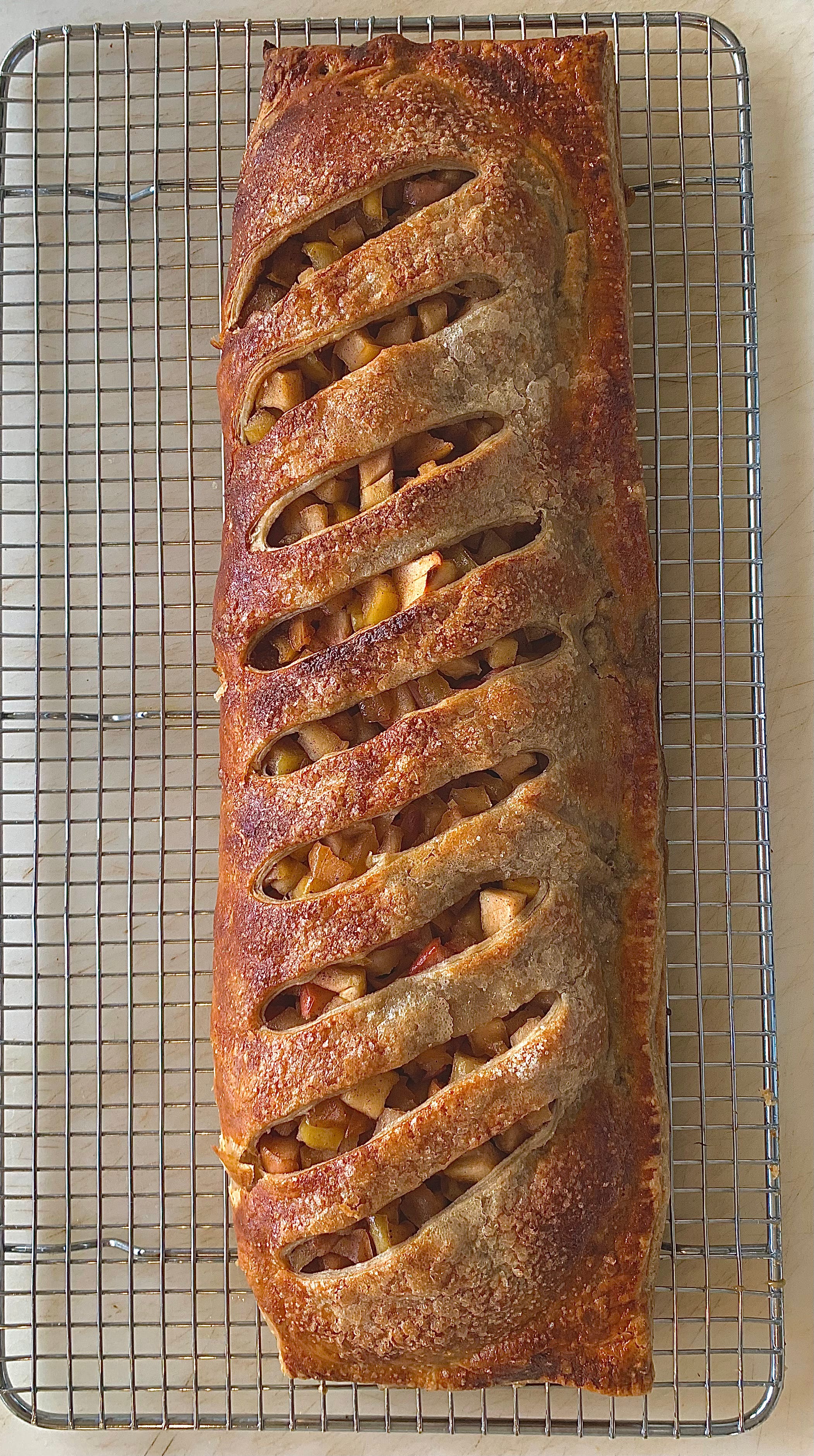
Remove the dough from the fridge and lightly flour your work surface. Roll out each dough round into as much of a rectangle as possible (this does not need to be precise). What we are going for is for the length of the dough to be longer than the width. Fold the dough like a trifold pamphlet. Cover with plastic wrap or a kitchen towel and let rest in the fridge for another hour. Repeat this process one-two more times, depending on the level of flakiness you’re after. The more folds you do, the more layers you’ll get (though there is a point of diminishing return), but honestly I’ve done it both ways many times and they are both delicious. Once you’ve done all your folds, you can roll the dough out to your desired tart shape. See mine above, a rustic rectangle. After you roll out your dough, place it back in the fridge (covered) for 30 minutes or so. At this point, you can use this dough like you would the pastry dough you buy from the store.
Apple Mix
This is a very loose recipe. Feel free to taste and adjust as you go, depending on your preferences.
4 apples, small diced
60g (4T) butter
100g (1/2C) maple syrup or organic sugar cane
1 tsp cinnamon
1 tsp cardamom
pinch of salt
1 egg
1 T organic cane sugar or Demerera sugar
Preheat oven to 375°F. Line a baking sheet with parchment paper.
Melt butter in a sauté pan. Add in diced apples and salt. Sauté until the apples begin to soften. Add in the maple syrup, cinnamon, and cardamom and continue to cook until apples are tender but still have a bite to them.
Remove apple mixture from heat. Make your egg wash by whisking one egg with a small splash of water, and combining until it until it reaches a homogenous mixture.
Roll out your puff pastry sheet into a large rectangle. Using a brush (or a folded up paper towel corner if you don’t have a brush) paint the border of the bottom half of the puff pastry. Place apple mixture in the middle of the pastry, and then spread out so it lays evenly, making sure to keep the outer border where you just put the egg-wash free of apple mixture.
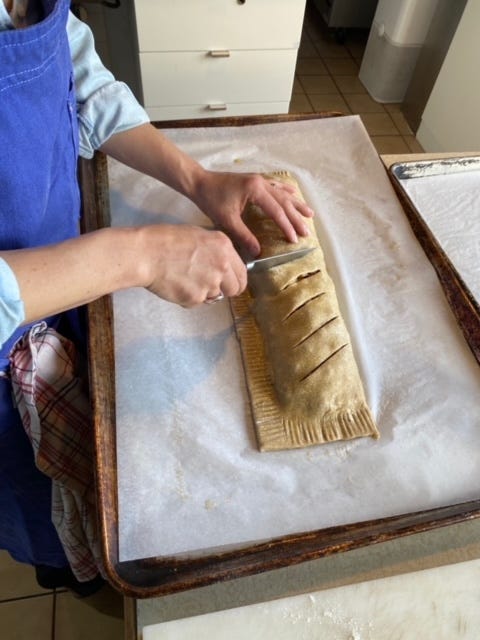
Close the puff pastry like you’re closing the lid of a box, pulling the pastry from back to front over the apple mixture. Using the back of the tines of a fork, press along the outer rim of the apple strudel to seal the puff. Then, make at least three slits in the top of the strudel to allow hot air to escape when baking. Brush the top of the turnover with egg wash and sprinkle with Demerera sugar.
Bake for 20-25 minutes (all ovens are different so pay attention), or until golden brown on top and bottom. If the turnover browns on the top before the bottom, place it on the bottom rack to speed up bottom browning.